
Publishing Scholarly Archaeology since 1997
Publishing Scholarly Archaeology since 1997
Log in | My Account | Basket Twitter Facebook LinkedIn
Advanced Search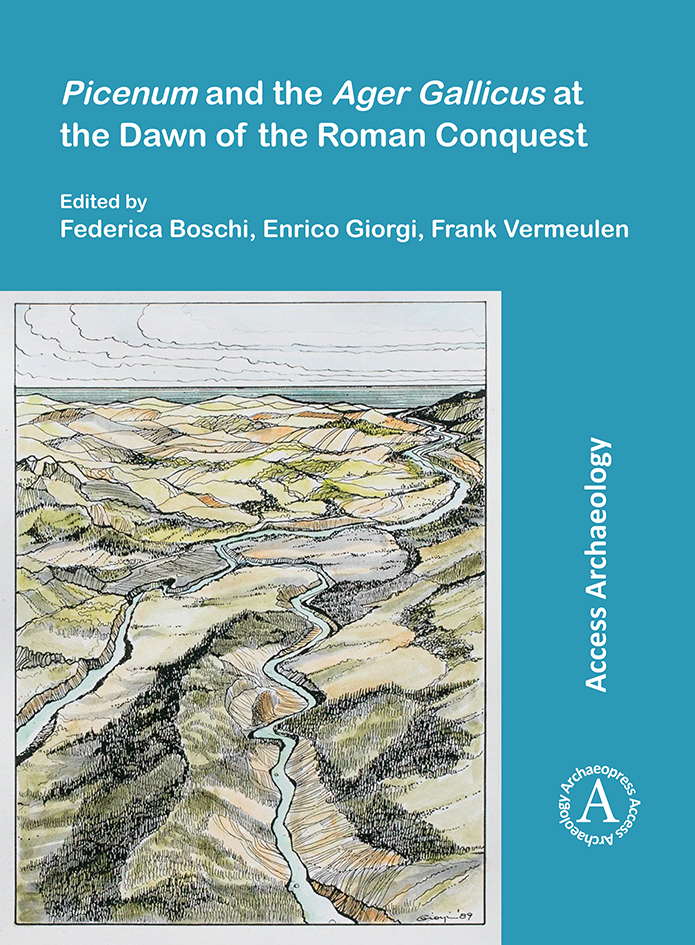
Download Sample PDF
H 276 x W 203 mm
232 pages
96 figures (colour throughout)
Published Nov 2020
Archaeopress Access Archaeology
ISBN
Paperback: 9781789696998
Digital: 9781789697001
Keywords
Romanization; Landscape archaeology; Marche; Northern Italy; Pre-Roman
Related titles
Picenum and the Ager Gallicus at the Dawn of the Roman Conquest
Landscape Archaeology and Material Culture
Edited by Federica Boschi, Enrico Giorgi, Frank Vermeulen

Paperback
£42.00
Includes PDF
PDF eBook
(personal use)
Free Download
PDF eBook
(institutional use)
£10.00
 Add to wishlist
This volume presents a coherent collection of papers presented at an International Workshop (held in Ravenna, 13-14 May 2019) which focussed on the transition between Italic culture and Romanised society in the central Adriatic area – the regions ager Gallicus and Picenum under Roman dominance – from the fourth to the second centuries BCE.
Contents
Introduction – F. Boschi, E. Giorgi, F. Vermeulen
I. P. Attema – Data integration and comparison in landscape archaeology: towards analysis beyond sites and valleys
II. A. Gamberini, P. Cossentino, S. Morsiani – Romanization dynamics through the material culture analysis in the Ager Gallicus et Picenum
III. O. Mei, L. Cariddi – Forum Sempronii and the Romanization of the Metauro Valley
IV. F. Boschi – Methodological approaches to the study of the Cesano and Misa River Valleys (2010-2020). New data: some thoughts and perspectives
V. E. Giorgi – The Cesano Valley at the outset of the Roman conquest and the genesis of Suasa
VI. M. Silani – Sena Gallica: a stronghold for the Roman conquest of the ager Gallicus
VII. A. Gaucci – Perspectives on the analysis of the settlement system in medio-Adriatic Italy between the late sixth-fifth and fourth centuries BC: the case study of the Cesano and Misa river valleys
VIII. V. Baldoni, S. Finocchi, M. R. Ciuccarelli – News from Ancona and Numana
IX. F. Vermeulen – Settlement dynamics from the fourth to the second century BC in the Potenza river valley (Marche): landscape approaches and some methodological issues
X. W. De Neef – A crossroads in the central Potenza Valley: non-invasive research into settlement (dis-) continuity at Monte Franco (Pollenza, Marche, Italy)
XI. R. Perna – Pollentia-Urbs Salvia during the Republican period
XII. E. Giorgi, F. Pizzimenti, S. Kay – The sanctuary of Jupiter at Monte Rinaldo: a sacred landscape in the heart of Picenum
XIII. F. Boschi, E. Giorgi, T. Casci Ceccacci, F. Demma – The Urban Archaeology Project in Ausculum. From civitas caput gentis to civitas foederata
XIV. V. d’Ercole, M.G. Di Antonio – Continuity and discontinuity in the archaeological record south of the Tronto river
Conclusions – F. Boschi, E. Giorgi, F. Vermeulen
Bibliography
About the Author
Federica Boschi is senior researcher in Methods of Archaeological Research at the University of Bologna. She specialises in non-destructive methods of investigation, in particular geophysics and aerial photography for archaeology. Her current work addresses the use of geophysical and remote sensing techniques for the study of ancient sites and landscapes, and their application to the feedback from trial archaeological excavations. She directs field projects in central Adriatic Italy and is a member of several teams conducting research of international significance.
Enrico Giorgi is Associate Professor of Methodology and Landscape Archaeology at the University of Bologna. He is the director of the journal ‘Groma: Documenting Archaeology’ and directs research on Adriatic archaeology. He conducts archaeological missions in Croatia, Albania and Egypt which are already the subject of publications. His interest in the archaeology of the city led him to coordinate projects in Pompeii, Paestum and Agrigento. He is President of the Archaeological Park of Suasa.
Frank Vermeulen has been Professor of Roman Archaeology and Archaeological Methodology at Ghent University since 1999 and directed its Department of Archaeology from 2015 to 2018. He is particularly interested in Roman settlement archaeology and geo-archaeological approaches to ancient Mediterranean landscapes; he has a keen interest in IT applications in archaeology. He is a renowned specialist in non-invasive field methods, such as aerial photography and geophysical prospection. Since 2000 he has directed large field projects in Italy, Portugal and France. Recently his research has focussed on the study of Roman colonialism and urbanism, in particular regarding central Adriatic Italy. His direction, during the last two decades, of a multidisciplinary field project in the Potenza Valley (Marche), forms part of this research.
Archaeopress Publishing Ltd
First and Second Floor
13-14 Market Square
Bicester
Oxfordshire OX26 6AD
United Kingdom
Tel +44 (0) 1865 311914 | fax +44 (0) 1865 512231 | email info@archaeopress.com
